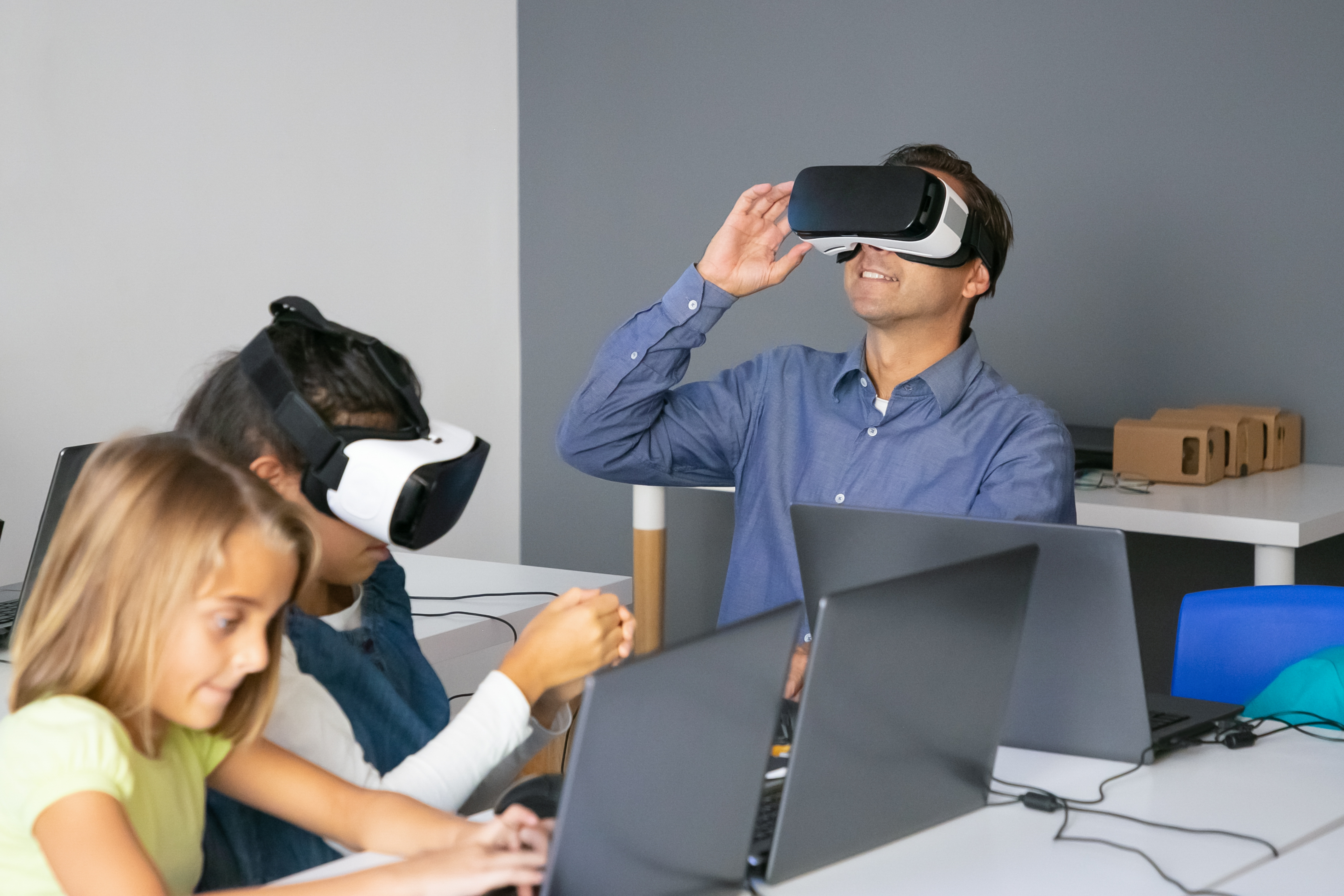
Training obstacles can be many, and they often demand adopting some kind of immersive technology that learners find likable. Importantly, this can involve crucial safety measures to overcome operational emergencies. Although traditional classrooms may prepare individuals to a certain extent, they may not be able to help them visualize or understand what actually happens in the workplace.
In other words, whether corporate or educational institutes, they may find it difficult to fill the knowledge gaps that are required to get the concepts properly into the minds of individuals.
So bridging this systematic gap requires some kind of forward innovation and technology that makes learning easy. This is especially useful when it comes to understanding abstract concepts that are difficult to imagine and only laid out in text format. This is where some kind of immersive learning technology, such as AR/VR eLearning development, can be very useful. Similarly, simulation-based learning development can be instrumental too.
Table of Contents:
1. Real-World Applications: Automotive Assembly Lines
2. Real-Life Application: Retail Customer De-escalation
3. Accelerating Onboarding For New Candidates
4. Upskilling Experienced Professionals Seamlessly
5. The Financial Impact of Virtual Training
6. University eLearning Development Eliminates Geographical Barriers
7. K-12 Schools Need More Visual Engagement With the Science of Physics
8. Cultivating A Safer Construction Industry
9. Manufacturing Quality Control Precision
10. Data Security and Phishing Defense
11. Customizing The Learning Experience
12. Identifying the Problems to the Core
13. Building Empathy In Corporate Leadership
14. Future-Proofing The Global Workforce
Real-World Applications: Automotive Assembly Lines
Historically, car companies have temporarily stopped production in order to train employees to use assembly equipment. This type of disruption creates a significant financial impact on industry-wide production rates.
Fortunately, simulation-based learning development principles apply to company training practices for new employees.
Take it to another level: AR/VR eLearning development provides an opportunity for staff to learn assembly processes virtually before working on assembly lines.
Real-Life Application: Retail Customer De-escalation
Retail companies often find their staff mismanaging irate, aggressive customers in their stores. Reading about conflict resolution doesn't really equip individuals for the shouting that often accompanies such encounters. Using the development of digital learning content, trainees can interact with avatars. This can help them to understand how to converse with customers in a proper way based on the training concepts that they have understood.
Accelerating Onboarding For New Candidates
Often, new employees find corporate policy documents overwhelming. And rightly so. Information retention is typically poor in such documents. Incorporating simulations, videos, and immersive learning content can make policy more engaging.
Upskilling Experienced Professionals Seamlessly
Many experienced people want challenging material in their training. And frankly, they find static presentations of policy insulting of their considerable knowledge of their own industry. On this basis, through interactive learning development, the process could build scenarios at their level of expertise.
The Financial Impact of Virtual Training
Poorly trained employees in global corporations cost billions of dollars in avoidable errors. And according to some estimates, the training market may be worth billions globally by 2035.
Thus, investing in AR/VR eLearning content development may play a big role, especially in bridging the desired result with the potential for long-term profit.
University eLearning Development Eliminates Geographical Barriers
Universities have traditionally had to restrict access to expensive scientific testing equipment to students based on where they live. Geographically distant students have not had access to the same resources as locally based students.
However, the game can be changed with university eLearning content development. The reason being it allows for advanced virtual laboratories to be accessible on students' laptops.
K-12 Schools Need More Visual Engagement With the Science of Physics
K-12 (Grade 1-12) schools may find it difficult or may be unsuccessful in helping students understand abstract concepts of physics. This happens especially through the use of crude diagrams and textbook illustrations. Textbook illustrations and diagrams have been ineffective in helping students visualize and understand the spatial and mechanical aspects of motion and mechanics.
However, with K-12 eLearning content development, molecular structures are brought to life, as this enhances students' visual comprehension and understanding.
Cultivating A Safer Construction Industry
Construction companies may suffer from high injury rates because of untrained newcomers who don’t know how to handle materials or instructions. Seizing the opportunity, firms will think of trying to avoid such risks. They may show videos in regard to the handling of tools in different locations, but video content may not convey the dangers of high heights.
Instead, when construction firms opt for simulation-based learning development, they show immersive learning content. This would help the staff to get an idea of how to handle materials at heights. This gives employees the possibility to get enough realistic impressions without any risks. The technology of developing interactive learning content may open new possibilities.
Manufacturing Quality Control Precision
Manufacturing companies demand very precise work from quality control specialists. Moreover, overlooking the smallest product flaws may lead to huge product recalls. Thus, it becomes important to avoid errors at all costs.
AR/VR eLearning development trains people to notice very tiny details. Furthermore, this method proves to be very efficient in developing the skills needed.
Data Security and Phishing Defense
Companies may lose valuable information because some employees might click on the links in misleading emails in a hurry. At the same time, it is not necessary that seminars on cybersecurity could manage to change any behavior patterns.
This is where the use of simulation-based learning could possibly help employees pass fake tests in absolute safety.
So the more fake attacks people face, the better they become at recognizing the threats.
Customizing The Learning Experience
People have different rates of absorbing new knowledge when it is presented in a way they prefer. As a result, some of them cannot adapt to strict plans of the learning process or a rigid training program. Hence, the implementation of immersive learning content makes it possible to tailor the learning process.
Moreover, at the university level, colleges and universities can even consider the incorporation of immersive learning content development as well. Additionally, eLearning in schools (K-12 courses) provides students with the same approach.
Identifying the Problems to the Core
Sending employees to different training centers may or may not work, as there is no guarantee that the needed training will help techies. This can be mainly because when lectures are presented in text format only, the trainees may not know exactly how to grasp the actual issue. This is where the use of interactive learning in the form of AR/VR eLearning development can help. This kind of development could help them understand what the actual problem is in different situations and how to handle them.
Interactive learning development enables companies to collaborate remotely without flying employees. Therefore, it helps to minimize the negative impact on the firm’s overall growth.
Building Empathy In Corporate Leadership
Leaders of companies may sometimes understand what their employees feel in different situations if they themselves are stressed. The same can happen even when they lack knowledge of how and what different kinds of diversity exist in a company.
Also, occasionally, it may so happen that diversity workshops may be dull and preachy.
AR/VR eLearning development provides managers with an opportunity to feel biased in workplaces as they go to the depth of the subject by experiencing it. Thus, interactive and immersive learning content may help them to learn how to understand their employees better.
Future-Proofing The Global Workforce
Industries change quickly, and new technologies come too, which makes some technical skills obsolete. Continuous education remains the only solution for survival in the market. Simulation-based learning development makes it possible to create programs that can be easily updated.