How Game-based Learning in E-learning Leads to Quick Understanding of Concepts: In-Depth Analysis
August 23, 2025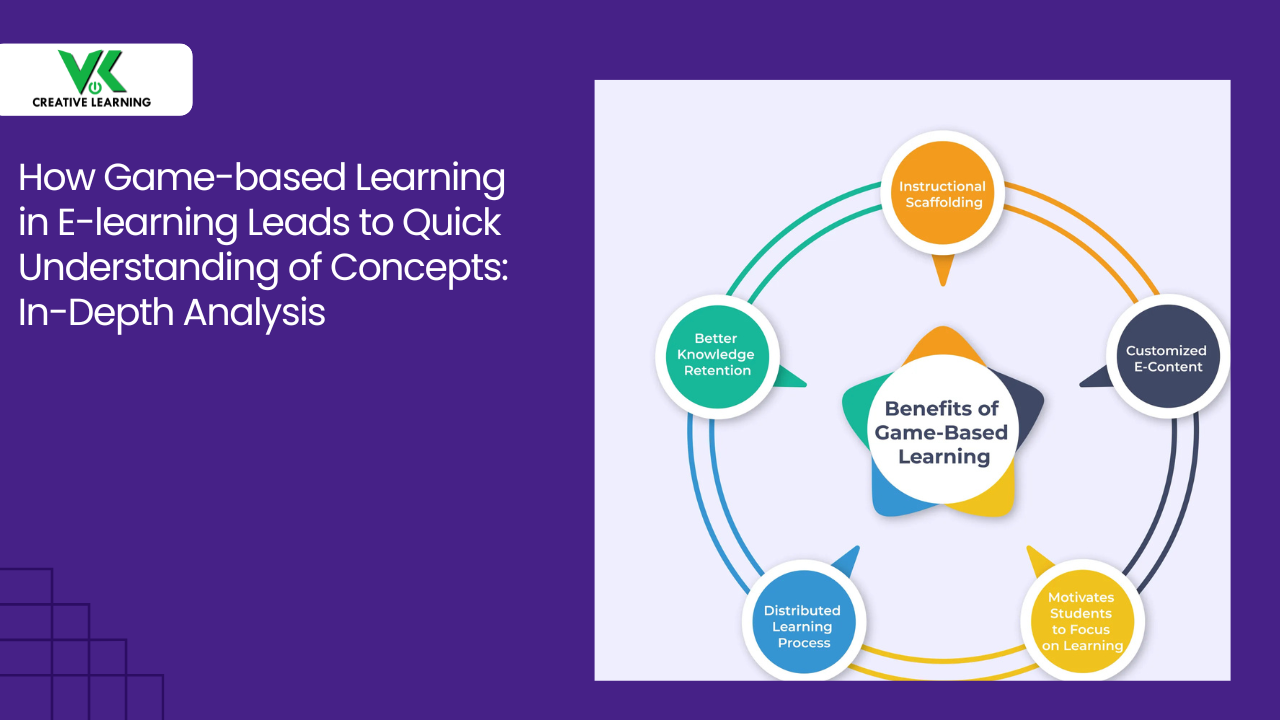
Game-based learning is a practice involving the use of various games. That is: teachers use games to teach concepts so that active learning is possible. The game is conducted with the idea of having goals from a learning perspective.
On completion of the games, students are rewarded if they follow the rules properly. However, this type of teaching cannot be implemented in every class by the teachers. The sole reason: they also have to cover the theory related to a topic.
This is exactly where the use of the e-learning platform with game-based learning proves helpful.
The best aspect about a customized e-learning platform is that it not only offers game-based learning modules but also 3D animations.
Elaborately, students are provided with 3D explanatory animation videos, simulations, and other types of helpful elements. What this does: it enhances the learning potential (to gain more knowledge) of the learners.
In addition to these learning elements, the platform also offers quizzes on a topic. Teachers can also assign homework and assignments to the students.
Hence, suppose a teacher completes a topic of a subject (math, science, etc). Immediately, the students can go through game-based learning examples and 2D/3D animations.
Using these elements in the e-learning platform aids them in getting a thorough understanding. This also helps to bring confidence in them regarding the subject or multiple topics. Going further, they no more fear subjects like mathematics or science.
Table Of Contents:
• A Look At How Game-Based Learning Differs from Gamification
1. Exact Difference--Game-based Learning vs Gamification
• Why Game-Based Learning Works So Quickly: What’s The Point?
• Types of Game-Based Learning Formats: A Quick Glance
1. Role-play games (story-world simulation game)
2. Puzzle Games
3. Simulation games (real-task experience game)
4. Adventure games (mission-based question trail)
• Application and Daily Life Examples of Game-Based Learning
1. From Students’ Perspective
2. Workplace Scenarios
• Game-Based Learning Encourages Active Involvement
• Concepts Become Concrete Through Repetition and Fun
1. Repetition-Based Games for Students
2. Repetition-Based Games for Professionals
• Better Memory Recall with Contextual Visuals and Sounds
A Look At How Game-Based Learning Differs from Gamification
Sometimes, there is confusion among many in regards to game-based learning vs gamification. This is caused since both terms sound similar and have a word game in them. Also, not many know the differences or even the types of game-based learning.
To start with, game-based learning (whole-game learning format) is different from gamification (points-and-badge system). In game-based learning, the idea is to teach lessons by implementing games. In gamification, lessons are traditional, but games give points and rewards for the sake of motivation.
One of the best ways to use game-based learning is for teaching a concept. The game can be in the form of a digital race game for solving math problems. In other words, the quicker the problems are solved, the more rewards or appreciation students earn.
Exact Difference--Game-based Learning vs Gamification
Precisely, math problems solved in a digital race game (speed-reward math game) are game-based learning. But, if students are rewarded with stars for solving homework (badge-for-task system), it is gamification. Both are helpful, but on comparison, game-based learning goes deeper when it comes to thorough learning.
Please note: the reward is in the form of badges/points for learning tasks. Even if points are used, they are used for understanding the progress of the learners.
So, be it gamification or game-based learning, the agenda is to encourage students. Importantly, the use of these concepts in an e-learning platform helps to understand the learners' lesson completion rate. Importantly, it gives a thorough picture of how well learners are comprehending topics.
Why Game-Based Learning Works So Quickly: What’s The Point?
Many people ask this question why game-based learning for an in-depth grasp of concepts.
Reason: our brains are tuned to learn faster when we play and repeat practice. And guess what, game-based learning examples precisely do that.
Game-based learning also helps to understand weaknesses, and instant feedback can be provided. Thus, with various types of game-based learning, the brain can lock concepts easily.
Simply put, when a student plays a game, he tries, fails, and keeps trying again, and ultimately gains. There is a high possibility that this aspect may be missing in learning from a textbook.
For example, a child playing a water-cycle game (process-path puzzle game) clicks through clouds, rain, and rivers. They learn the sequence (ideas/concepts connected to each other) quickly.
Another child solving a multiplication maze (fast-counting action maze) remembers tables. This can happen when aspects of action, sound, and trial are introduced in game-based learning.
Types of Game-Based Learning Formats: A Quick Glance
When it comes to game-based learning types, there are many. We have explained about various types of game styles and the most used ones hereunder:
Role-play games (story-world simulation game): In this type of game, learners are assigned certain characters and asked to make decisions.
Through their experience as a character, they are asked about their conceptual understanding. Also, as the game proceeds, their decisions are questioned to conclude it.
Puzzle Games: The puzzle games (logic-challenge path builder) involve learners in solving various types of problems. These can be simple ones or challenging ones based on the levels (difficulty levels). They have to complete the puzzle (stage-wise) and proceed ahead with each level.
Simulation games (real-task experience game): These ones are based on real-life situations of subjects like science or geography. Students are made to apply concepts in farming or understanding the atmosphere.
Adventure games (mission-based question trail): Children have to follow a given adventurous path and keep unlocking knowledge along the way.
By playing each type of these games, student gets an understanding of the topic from different angles.
Elaborately, certain games are made to understand their comprehension of the topics. Certain games are designed to see their reaction when concepts are applied to real-life situations.
Each of these types builds different skills: memory, logic, planning, and decision-making.
Application and Daily Life Examples of Game-Based Learning
From Students’ Perspective: Game-based learning through e-learning can be used to teach kids how to count. This can be in the form of a number color matching game. Elaborately, they should count the number of apples in a given cart. If they are able to answer correctly, they are given virtual points or rewards.
Game-based learning examples can also be in the form of match columns for students. That is, they have to match certain things on the left and right sides.
On the left side, there can be a different number of apples. On the right, there can be numbers (match the number of apples with the numbers). This form of matching helps to develop reasoning capabilities and mental math.
Importantly, be it gamification or game-based learning, the students can learn without any pressure. There are also a lot of fun elements involved, and they start enjoying mathematics.
Workplace Scenarios: Game-based e-learning can be used by doctors to practice medical or treatment theories. It can also be used by the nurses to understand patient care and the use of medical equipment.
It can be used by engineers to understand different parts of a machine and their functioning. It can be used by pilots with flight simulators (flying-error correction game) to learn handling.
So, in general, games on virtual environments are not just for kids--they help professionals too.
Game-Based Learning Encourages Active Involvement
It has been noticed that children learn at their best when they do things practically. And guess what, game-based e-learning precisely does it by teaching them practically.
The games in e-learning are designed smartly to engage learners in every possible way. That is, children have to think more and work on the taught concepts.
Precisely, games are created such that learners have to move, think, click, drag, and then decide.
This is applied to even professionals as they can learn or upskill through virtual games.
This kind of involvement leads to active learning, as learners get involved actively. In contrast or usual methodology, learners just sit, listen, and write—passive learning.
Example: a game can be such that students have to dress animals based on the weather (weather-suit match-up game). In such cases, children have to think, and they actively apply what they know.
Similarly, when it comes to science, e-learning provides a quiz battle (fact-fight game round). In this case too, learners have to answer quickly based on their knowledge.
Concepts Become Concrete Through Repetition and Fun
Learning through usual play can be repetitive in nature--means more practice. So, obviously, through traditional teaching, just teaching theory can be boring for learners. But in games, repetition of concepts happens, but through different types of game-based learning.
This is equally applicable to students and professionals who want to upskill.
Repetition-Based Games for Students
Suppose there is a number-jumping game (count-path in a jumper puzzle course). In such games, a child has to repeat skip-counting until they get it thoroughly.
Similarly, when it comes to a geography-based game (hints with country clues), they see flags and capitals many times. This sort of game-based learning example ends up making the learners' concepts stronger.
Repetition-Based Games for Professionals
A chemical engineer will be asked to use chemical formulas in different workplace conditions through games. Thus, new joiners can understand the industry requirements quickly this way.
Corporate e-learning entails onboarding exercises for new employees. Under this training, they are made to go through several workplace tasks. For this purpose, e-learning games are used unless they become thorough with work activities.
Better Memory Recall with Contextual Visuals and Sounds
It has been observed that people can remember a lot when different types of sensory hints are provided. This means that they learn quickly in a better way when they see, hear, and act.
Game-based learning elements precisely do this to ensure concepts get ingrained in learners’ minds.
For the same, they make use of sound elements, colors, different types of shapes, and movement. These forms of brain-attention holding activities ensure that multisensory learning happens. Importantly, the concepts are remembered for a longer period of time and can be recollected as when needed.
Example: a type of game-based learning can be a color-mixing paint game (that is: mix colours to create new ones). Thus, children smartly put their brains to work and learn which colors to mix.
In a grammar detective game (rule-based), they learn to pick the right words. In such situations, hints to students are provided through clues and music cues. These activities aid the brain in connecting the action to the taught concepts.
Conclusion: Why Choose VKCL for Game-Based Learning and Benefits
Game-based learning has been observed to bring life to lessons. It plays a vital role in building memory and promotes in-depth concept understanding.
VK Creative Learning (VKCL) understands these and hence, offers custom-made e-learning games.
These are smartly designed for each learner’s needs--learning styles and different paces.
With VKCL, schools and firms get smart, interactive tools that make lessons playful and meaningful. These games ensure every child, fast or slow, gets to enjoy, try, and learn.
They can use the learned concepts anywhere, repeat as needed. This way, learners (esp. professionals in a tight market) stay relevant for years.
All in all, VKCL stands out in blending fun with purpose--and making learning stick in the best way.
Recent Blogs